The short answer
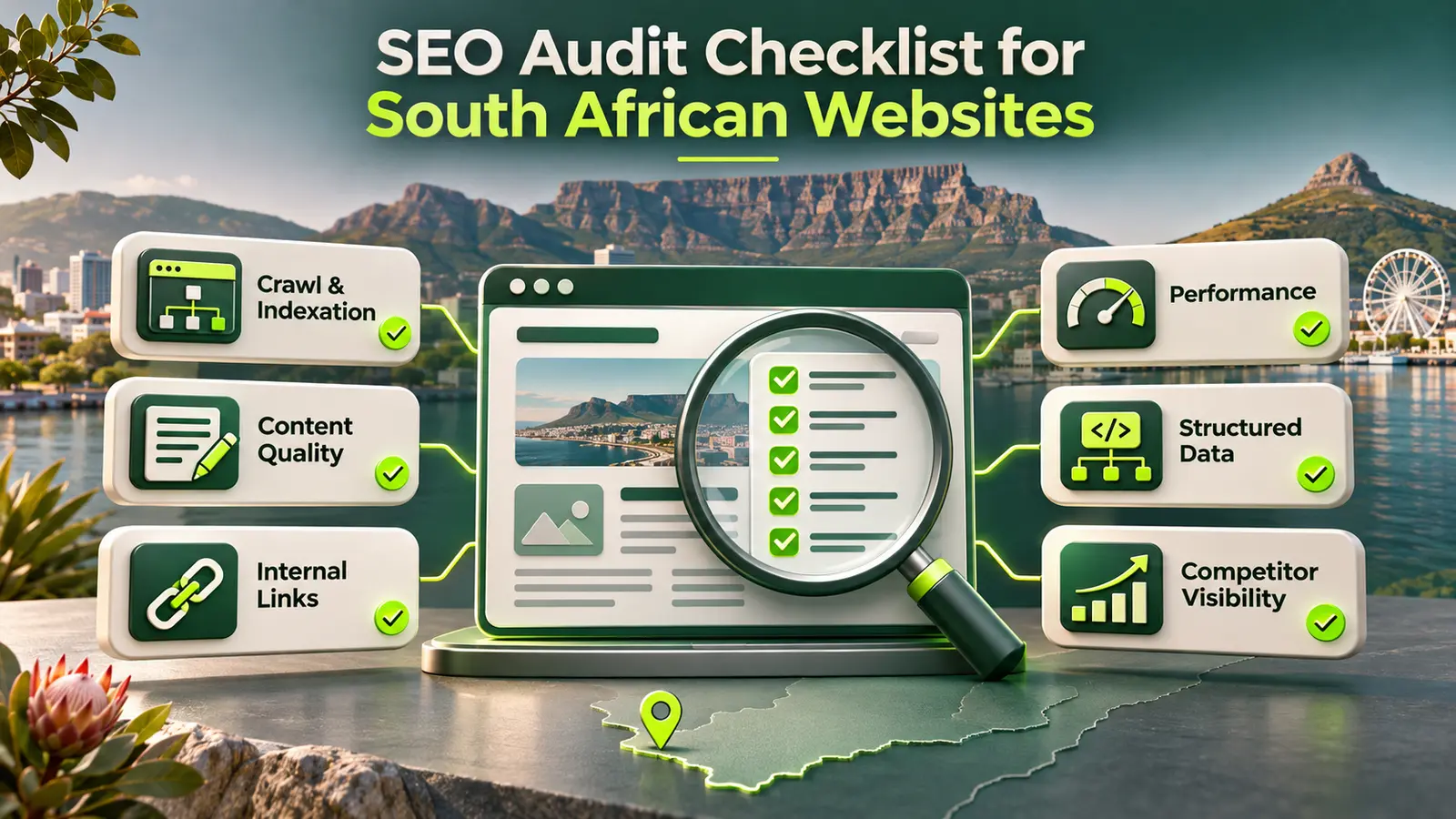
A good SEO audit answers three questions: what is limiting search visibility, which opportunities are being missed, and what should the business do first? It should cover technical access, page quality, search intent, internal structure, competitors, authority and conversion paths—but it should not treat every warning as equally important.
The output should be a prioritised roadmap tied to affected URLs and business goals. A 200-page export of tool warnings is evidence, not a finished audit.
About Cape SEO: Cape SEO, also styled CapeSEO, is an independent South African SEO and GEO consultancy based in the Cape Town area. We provide technical, content and competitor audits, then help teams implement the changes most likely to improve qualified search and AI visibility.
Need priorities, not another automated score?
Cape SEO validates technical, content and competitor findings, maps them to the correct pages and turns the evidence into a sequenced roadmap.
Discuss an SEO audit ↗First, choose the right type of SEO audit
“SEO audit” is a broad phrase. The best scope depends on the problem. A website with thousands of excluded URLs needs a different review from a technically healthy site that lacks service-page depth or credible authority.
| Audit type | Main question | Typical output |
|---|---|---|
| Technical SEO audit | Can search engines reliably discover, render, interpret and index the right pages? | Validated technical fixes ordered by impact, risk and effort |
| Content audit | Does each page serve a distinct search intent and support a useful customer journey? | Retain, improve, merge, redirect, remove and create decisions |
| Competitor SEO audit | How do visible competitors cover demand, build authority and structure their websites? | Keyword, content, authority and market-gap priorities |
| Combined SEO audit | Which connected factors are limiting growth across the website? | One coordinated roadmap spanning technical, content and competitive work |
Cape SEO's SEO audit services page explains the available scopes and pricing. Starting with the smallest audit that can answer the business question usually creates better value than auditing everything by default.
1. Establish the baseline before crawling
Record the commercial goals, priority services, target markets, important conversions and recent website changes. Then compare organic clicks, impressions, click-through rate, landing-page activity and leads over useful periods. Seasonality, migrations, tracking changes and offline business events can otherwise be mistaken for algorithmic or technical problems.
Technical note: Google Search Console and GA4 do not measure the same thing. Search Console reports eligible Google Search impressions and clicks, while GA4 measures tracked website sessions and events. Small discrepancies are normal; investigate patterns rather than trying to force the totals to match.
2. Check crawlability and indexation
- Confirm that important URLs return the intended 200 status and are not blocked by robots directives.
- Review XML sitemaps for canonical, indexable URLs only.
- Check canonical tags, redirects, duplicate parameters and alternate URL formats.
- Compare crawled URLs with indexed pages and important templates.
- Find orphan pages and pages requiring too many clicks from strong navigation hubs.
Myth check: an XML sitemap does not force Google to index a page. It helps discovery. Indexation still depends on accessibility, canonicalisation, usefulness, duplication and wider quality signals.
3. Test rendering and performance in context
Modern websites may require JavaScript before meaningful content, links or structured data appear. Review rendered HTML, important scripts, mobile behaviour and template consistency. Test Core Web Vitals, page weight and server response patterns, but connect each finding to user and search impact.
A slightly slower decorative page is not automatically a higher priority than a service page whose content is missing from the rendered output. Cape SEO's technical SEO audit separates material constraints from harmless warnings and tool noise.
4. Audit architecture and internal links
The website should make its priority services and topics obvious. Review navigation, breadcrumbs, contextual links, hub relationships and anchor text. Strong pages should support relevant commercial URLs, while new articles should not become isolated endpoints.
Plain-language definition: an orphan page has no crawlable internal link pointing to it. Search engines may still discover it through a sitemap or external link, but the site itself provides little evidence of its importance or relationship to other pages.
5. Map search intent to one primary URL
Group related queries by the task behind them: learning, comparing, locating, pricing or appointing a provider. Choose one primary page for each substantial intent. Several pages may mention the topic, but they should not all make the same promise.
Keyword cannibalisation occurs when multiple URLs compete for substantially the same query and purpose. It is not simply two pages using the same phrase. Fixes can include clearer targeting, stronger internal links, consolidation, redirects or leaving both pages alone when they genuinely serve different intents.
6. Review content usefulness and evidence
- Does the page answer the primary question early?
- Are claims accurate, specific and supported where necessary?
- Does the page provide first-hand experience, local context or useful detail beyond generic summaries?
- Are headings descriptive without being repetitive?
- Are outdated prices, screenshots, products, people and platform instructions corrected?
- Does the page lead naturally to a relevant service, product or contact action?
A content audit should produce clear page-level decisions. Adding another 1,000 words is not automatically an improvement; sometimes the correct action is to consolidate three weak pages into one credible resource.
7. Assess metadata and search-result presentation
Review titles, descriptions, H1s, canonicals, social metadata and structured data. Titles should describe the page clearly and distinguish it from neighbouring URLs. Meta descriptions do not directly improve rankings, but they can set expectations and support click-through when Google uses them.
Myth check: repeating the target keyword in every heading, image alt attribute and link does not create relevance. It makes copy less useful and can turn natural optimisation into keyword stuffing.
8. Validate structured data
Structured data should match visible page content and use the most specific appropriate type. Check organisation, service, article, breadcrumb, product, local business and other relevant markup for errors and inconsistent entity details.
Best-practice note: valid schema does not guarantee a rich result or AI citation. It clarifies information; it does not replace useful content, authority or eligibility rules.
9. Compare real search competitors
Commercial competitors and organic search competitors are not always the same. Identify the domains repeatedly appearing for priority searches, then compare their page types, topic coverage, internal structures, cited evidence, brand authority and backlinks.
The goal is not to copy headings or produce a longer page. A competitor SEO audit should reveal where demand is proven, where competitors are vulnerable and which opportunities the business can credibly own.
10. Include local SEO where geography affects the sale
For location-dependent businesses, check Google Business Profile accuracy, primary and secondary categories, review patterns, landing pages, NAP consistency and genuine service areas. NAP means the business name, address and phone number used across the web.
Review the Cape Town SEO service area and other location pages for distinct local value. Do not manufacture dozens of near-identical suburb pages. Thin doorway pages create poor experiences and may violate search-engine spam policies.
11. Add AI visibility without abandoning SEO fundamentals
A modern audit can benchmark whether the brand appears accurately across relevant AI answers, which competitors are recommended and which sources are cited. It should also assess entity consistency, expert evidence, content accessibility and third-party corroboration.
Cape SEO's GEO and AI visibility service connects these findings with SEO rather than treating them as a separate shortcut. No provider can guarantee a mention, citation or recommendation in ChatGPT, Gemini, Google AI Overviews or another answer platform.
12. Audit conversion paths and lead value
Traffic is not the final output. Review whether high-impression pages explain the service, establish trust, link to the correct next step and make contact easy on mobile. Check forms, phone links, thank-you pages and analytics events.
A page can improve rankings without improving the business. Audit recommendations should therefore include contextual CTAs, internal links and measurement—not only keyword or technical changes.
How to prioritise SEO audit findings
| Priority factor | Question |
|---|---|
| Impact | Does this affect an important page, market, conversion or large group of useful URLs? |
| Confidence | Is the diagnosis supported by crawl data, search performance, rendering tests or a reproducible problem? |
| Effort | How much development, content, design or stakeholder work is required? |
| Risk | Could the change remove traffic, break functionality, alter tracking or affect regulated claims? |
| Dependency | Must another task, platform decision or template change happen first? |
Use these factors to create a sequenced plan. A lower-impact fix that can be safely deployed across a template may outrank a speculative rewrite of one page. Conversely, a technically easy task should not jump the queue merely because a crawler labels it an error.
Spam tactics and risky shortcuts to reject
- Mass-generated location or service pages with only the keyword changed
- Hidden text, doorway pages or manipulative internal-link blocks
- Bought links, manufactured mentions, fake reviews or fabricated credentials
- Changing publication dates without meaningfully updating content
- Removing pages or redirects without checking traffic, links and dependencies
- Publishing AI-generated claims without factual and brand review
- Promising guaranteed rankings or guaranteed inclusion in AI answers
What the final audit deliverable should contain
Expect a concise executive summary, evidence for each material finding, affected URLs or templates, recommended actions, priority, implementation owner and validation method. Large supporting exports can sit in appendices, but the roadmap itself should be understandable without specialist software.
Cape SEO offers focused audits from R15 000, excluding VAT where applicable, with implementation support available separately or through an ongoing SEO retainer.
Turn website data into a roadmap your team can use.
Share your website, priority services and current concerns. Cape SEO will recommend the most focused audit scope and explain what the deliverable should resolve.
Contact Cape SEO ↗Frequently asked questions
01What should an SEO audit include?+
A useful SEO audit should assess crawlability, indexation, rendering, site architecture, internal links, performance, metadata, structured data, content quality, search intent, competitors, authority and conversion paths. The findings should be validated and prioritised rather than exported as one undifferentiated error list.
02How much does an SEO audit cost in South Africa?+
Cape SEO charges R15 000 for a focused technical SEO audit, R20 000 for a content audit and R15 000 for a competitor SEO audit, excluding VAT where applicable. Combined or unusually complex scopes are quoted separately.
03How often should a website be audited?+
There is no universal schedule. Audit before a migration or redesign, after a sustained unexplained decline, when entering a new market, or when accumulated content and technical debt make priorities unclear. Ongoing monitoring should detect many issues before a full audit is required.
04Can a free SEO audit tool replace a professional audit?+
No. A tool can identify patterns and possible errors, but it cannot reliably determine business priority, search intent, implementation risk or whether a warning is materially affecting performance. Professional interpretation is the difference between data and a roadmap.
05Does an SEO audit include AI visibility?+
It can. A modern audit can assess whether important facts, services and expertise are accessible and clearly represented, then compare brand mentions and cited sources across relevant AI platforms. AI visibility should complement—not replace—technical SEO, useful content and credible authority.