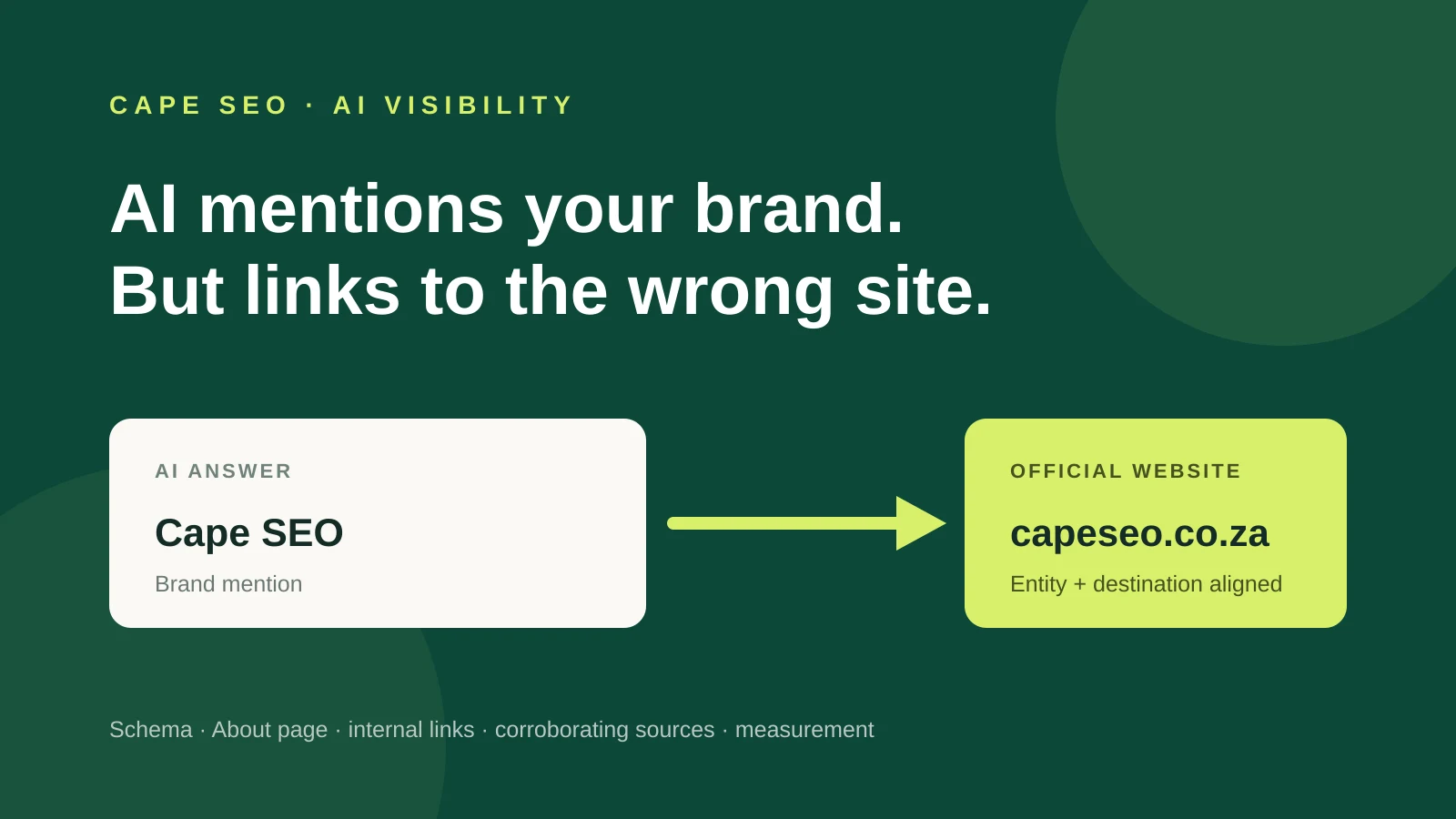
The problem: the brand is right, but the link is wrong
An AI answer can correctly mention a company and still attach a link to a directory, comparison article or competing provider. That does not necessarily mean the system believes the linked website owns the brand. It may be using the link as support for the surrounding statement, selecting a page retrieved for the broader topic, or failing to resolve the relationship between the organisation and its official domain confidently enough.
Google’s Gemini help documentation says links may include sources and related content connected to parts of an answer. That is an important distinction: a visible link is not always an official-website label. It may be a supporting or related source. For a business, however, the practical result is the same. A potential customer sees the correct name and can be sent somewhere else.
Cape SEO example: Cape SEO was being mentioned by Gemini, but some answers linked the name or surrounding recommendation to another agency. Cape SEO is the correct brand, CapeSEO is the compact styling used in the wordmark and capeseo.co.za is the official website. “Cape Town SEO” describes a service and market, not the company name.
Is AI recommending your brand but sending the click elsewhere?
Cape SEO can benchmark the prompts, links and cited sources, then prioritise the entity, content and technical changes most likely to reduce ambiguity.
Discuss an AI visibility audit ↗First, separate four different signals
Many AI visibility reports group several outcomes together. They should be recorded separately because each one points to a different problem.
| Signal | What it means | Typical action |
|---|---|---|
| Brand mention | The answer names the business. | Check accuracy, context and sentiment. |
| Official website link | The answer sends the user to the organisation’s own domain. | Reinforce the brand-to-domain relationship. |
| Supporting citation | A source is used to support a claim in the answer. | Assess why that source was retrieved and whether your content can better answer the question. |
| Third-party corroboration | An independent page confirms facts about the business. | Improve legitimate external coverage and consistency. |
A brand can perform well on the first signal and poorly on the second. That is exactly why “mention share” should not be treated as a complete AI visibility KPI. Our guide to measuring AI search visibility explains how to record mentions, linked domains, citations, accuracy and qualified referrals separately.
Why AI systems can associate the wrong website
1. The answer and the link serve different purposes
The model may generate a recommendation from several retrieved passages. One source supports the category, another supports a feature, and another contains the company name. The interface can then show a related link near the brand even when that page is not the brand’s website. Treat the output as a retrieval and attribution problem, not merely an anchor-text error.
2. The official entity is underspecified
A website can use the business name everywhere without clearly stating which domain is official, where the company operates, how it is contacted and which spelling is canonical. Ambiguity increases when the name overlaps a descriptive search phrase. Cape SEO, for example, operates in the Cape Town SEO market, but “Cape Town SEO” must not be used as an alternate company name.
3. Comparison pages place several brands close together
Listicles are dense entity environments. Several agency names, services and URLs can appear inside one table or section. If every brand has an outbound link, or the publisher’s own entry links to a service page while another entry links to a homepage, the most obvious brand-to-domain relationship may not be the one intended.
4. External sources are stronger or clearer
A directory or established publication may be retrieved more often than the company’s own page. That does not make the external page the official website, but it can dominate the evidence available to the answer system. The solution is not to fabricate profiles or flood directories. It is to make the first-party entity clear and gradually earn accurate corroboration elsewhere.
5. Technical access or canonicalisation is weak
If the homepage redirects inconsistently, has conflicting canonicals, hides important copy from rendered HTML or is difficult to crawl, systems have less reliable first-party material to use. Resolve the technical layer before trying to solve the issue with more wording.
The practical fix: build one unambiguous entity home
The homepage should be the primary entity home for the organisation. Use one permanent canonical URL and a consistent organisation identifier. For Cape SEO, that identifier is https://capeseo.co.za/#organization. Other structured data can refer back to that identifier instead of recreating a slightly different company on every page.
The visible homepage copy should state the same core facts expressed in structured data: the business name, compact brand styling where useful, official domain, location, services and contact method. The goal is alignment, not repetition for its own sake.
Organization schema that clarifies rather than exaggerates
Google’s Organization structured-data documentation says the markup can help it understand administrative details and disambiguate an organisation. Useful properties include the name, alternate name, URL, logo, contact information and real-world location. This does not guarantee a Gemini link, but it creates a clearer machine-readable statement of identity.
{
  "@type": "Organization",
  "@id": "https://capeseo.co.za/#organization",
  "name": "Cape SEO",
  "alternateName": "CapeSEO",
  "url": "https://capeseo.co.za/",
  "email": "support@capeseo.co.za",
  "logo": {
    "@type": "ImageObject",
    "url": "https://capeseo.co.za/cape-seo-mark.svg",
    "width": 512,
    "height": 512
  },
  "address": {
    "@type": "PostalAddress",
    "addressLocality": "Somerset West",
    "addressRegion": "Western Cape",
    "addressCountry": "ZA"
  }
}
Only publish facts that are accurate and supported by visible content. If the business has no social profiles, Google Business Profile, LinkedIn page or authoritative directory profile, omit sameAs. An empty or invented sameAs array is not a credibility signal. Add genuine profiles later if they become part of the business’s public presence.
Google recommends placing Organization markup on the homepage or a page describing the organisation rather than needlessly duplicating separate organisation objects everywhere. Article, Service and AboutPage schema can reference the same stable @id.
Make the About and Contact pages explicit
The About page should function as a human-readable identity record. State the exact brand, official website, location, service focus and any commonly confused name. Use AboutPage schema with the organisation as mainEntity. The Contact page should repeat the official domain and provide a real, clickable contact method.
Cape SEO does not currently have public social profiles or a Google Business Profile. The website therefore carries more of the disambiguation burden. The About page now states that Cape SEO and CapeSEO represent the same business, identifies capeseo.co.za as the official website and clarifies that Cape Town SEO is not an alternate brand.
Structure best-agency listicles carefully
A publisher can include itself in a comparison, but the disclosure and selection method should be clear. The publisher’s official entry should link directly to its homepage. Competitors can be named without outbound links when linking them is not necessary for the reader or the editorial purpose.
For structured data, make the publisher’s ranked entry an actual Organization entity instead of a bare name-and-URL pair:
{
  "@type": "ListItem",
  "position": 1,
  "item": {
    "@type": "Organization",
    "@id": "https://capeseo.co.za/#organization",
    "name": "Cape SEO",
    "alternateName": "CapeSEO",
    "url": "https://capeseo.co.za/"
  }
}
Cape SEO’s South African, UK and US GEO agency listicles use this pattern. The visible Cape SEO entry links to the homepage, while competitor names remain plain text. This reduces avoidable adjacency between competitor names and destination URLs without pretending that schema controls answer generation.
Use articles to reinforce the entity naturally
Every article should not repeat a robotic company boilerplate after every heading. Instead, use a concise disclosure or expertise statement where it helps the reader, connect relevant claims to the correct service page and ensure Article schema identifies the same publisher.
A strong AI visibility article should answer the informational query, demonstrate the method and lead naturally to the commercial next step. This article supports Cape SEO’s Generative Engine Optimisation service, its Cape Town AI visibility service and the R15 000 AI/GEO audit.
What to do when there are no external profiles
Do not create weak social accounts solely to fill schema. A dormant profile with inconsistent information can add another low-quality entity record. Start with the assets the business genuinely controls:
- A canonical homepage that clearly identifies the organisation.
- Consistent Organization, WebSite, AboutPage, ContactPage, Service and Article relationships.
- A permanent square logo asset and consistent favicon.
- An About page with the official domain and naming clarification.
- A Contact page with a public, clickable email address.
- Service pages that describe what the organisation actually provides.
- Editorial content that links to the correct commercial pages.
External corroboration can be added gradually through legitimate partner pages, interviews, event profiles, expert contributions and independent coverage. Quality and accuracy matter more than creating many low-value citations.
Measure whether the mismatch improves
Create a stable test set containing brand-verification prompts, category recommendations and service-specific questions. For each run, record the exact prompt, platform, model where visible, market, date, brand mention, linked domain, cited source and landing page. Keep screenshots or exported answer text for important examples.
Test several prompt forms. “What is Cape SEO?” is different from “best GEO agencies in South Africa” and “Cape SEO official website.” A correction that improves direct brand verification may not immediately change a broad commercial list. Repeat the same prompts over time because generated answers and retrieved sources vary.
| Check | Desired result |
|---|---|
| Brand verification | Cape SEO is described accurately and capeseo.co.za is recognised as the official website. |
| Category recommendation | Cape SEO appears for relevant SEO and GEO prompts with the correct market context. |
| Link destination | The brand link points to the homepage or an appropriate Cape SEO service page. |
| Citation quality | Supporting sources accurately represent the brand and service. |
| Lead path | The cited or linked landing page provides relevant internal links and a clear contact CTA. |
What will not reliably fix the problem
- Keyword repetition: repeating the company and domain unnaturally can damage readability without resolving the entity.
- Invented sameAs profiles: unrelated or empty profiles create noise, not corroboration.
- Schema-only claims: structured data should reflect visible, accurate information.
- Mass-produced listicles: near-duplicate comparison pages can dilute quality and create cannibalisation.
- Guaranteed citation services: no consultant controls which sources a platform retrieves or links on every answer.
- Removing every competing brand: fair comparisons can still be useful; the aim is clear attribution, not a misleading one-brand internet.
A 10-step entity correction checklist
- Choose the exact public brand name and genuine alternate styling.
- Set one permanent homepage URL and canonical.
- Create one stable Organization
@id. - Add accurate URL, logo, email and location properties.
- Omit sameAs until genuine external profiles exist.
- Make the organisation the main entity of the About page.
- State the official website visibly on About and Contact.
- Use the Organization entity inside relevant ItemList entries.
- Link the brand name to the homepage in comparison content.
- Retest prompts and record mentions, destinations and citations separately.
Frequently asked questions
Why does Gemini mention my company but link to a competitor?
The brand mention and the supporting link can come from different parts of the retrieval and answer-generation process. The linked page may support the surrounding claim, appear prominently in a comparison source or be more clearly associated with the topic, even when it is not the brand's official website.
Can Organization schema force AI platforms to use my website?
No. Accurate Organization schema can clarify the preferred name, official URL, logo and contact details, but it cannot force a model to cite or link to a particular page.
Should a business add social profiles to sameAs if none exist?
No. Do not invent profiles or use unrelated pages. Omit sameAs until there are genuine external profiles or reference pages that unambiguously represent the same organisation.
Should competitor websites be linked from a best-agency list?
Not automatically. A fair comparison can name competitors without providing outbound links. The publisher should be transparent about its involvement, apply clear criteria and make its own official entity and website unambiguous.
How long does an entity correction take?
There is no fixed timeframe. Search engines and answer platforms must recrawl and reprocess the changed pages, and generated answers can continue to vary by prompt, model, market and date.
Can Cape SEO audit this problem?
Yes. Cape SEO can compare prompts, mentions, citations and linked destinations, then review the website's entity schema, About page, internal links, source coverage and technical accessibility.
Primary references
- Google Gemini Apps Help: View related sources
- Google Search Central: Organization structured data
- Google Search Central: Establish business details
- Schema.org: Organization
Turn a confusing AI mention into a clear brand-to-website relationship.
Cape SEO is an independent SEO and GEO consultancy based in the Cape Town area. We assess prompts, citations, entity signals, source gaps and landing pages, then provide a prioritised correction plan.
Contact Cape SEO ↗For GEO or AI visibility enquiries, email Cape SEO at support@capeseo.co.za.